


The stages throw a constantly changing stream of challenges at Sonic, from the most basic moving platform to robotic bugs that chase him along an interstellar energy highway and require fast reflexes to outwit. The sheer volume and variety of these new level "features" -- many of which are specific to only one of the game's worlds -- constantly surprised (and often delighted) me. Sometimes I found myself thinking that this was the Sonic game I'd always wanted in 3D, like its designers had transitioned straight from 16-bit to Wii and had all these amazing new tools at their disposal.

Pac-Man is one of gaming’s oldest icons. He has survived 30 years by eating power pellets and chasing ghosts around various mazes. During the heyday of arcades he was featured in over 10 different cabinets and has since moved on as the mascot for Namco Bandai. To celebrate 3 decades of entertainment Namco has released an updated version of 2009’s Pac-Man Championship. Should you spend 800 Microsoft points to help them celebrate? Read on to find out.
The classic gameplay formula of Pac-Man has always been pretty simple. You control Pac-Man with the goal of eating dots and avoiding ghosts until you clear the entire board to advance to the next level. In the classic game in order to eat ghosts you would eat a “power pellet” that turned the ghosts an alternate color and they would avoid you. Namco has taken this tried and true formula and made several key changes to modernize Pac-Man. All of these additions make for an impressive retro inspired arcade title. In Championship DX Pac-Man’s goal is still to eat all of the power pellets on screen. Instead of advancing to a new board the game will spawn new pellets and ghosts once a fruit has been eaten. This means that Pac-Man has to always manage a large string of ghosts. Instead of limiting the number of ghosts per board, the baddies from the previous round will remain on the screen leading to a large snake like tail that will follow our yellow hero. There are several other enhancements to the gameplay that really add to the enjoyment of Pac-Man DX. Here is a brief breakdown:
Timed Gameplay - Rather than focusing on the clearing pre-set number of boards the gameplay in Pac-Man Championship Edition DX is based around timed gameplay. As the clock countdown in the main mode you’re in a race against time to collect the highest score possible.
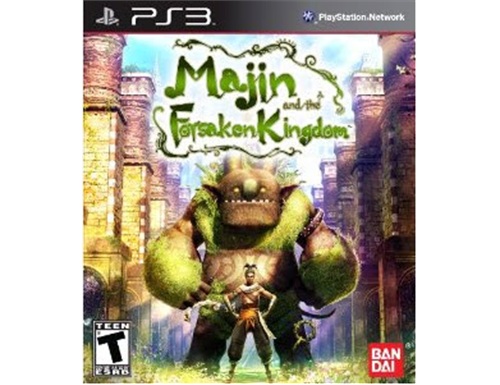
Majin and the Forsaken Kingdom immerses players into a land that has been devoured by darkness. No one in the kingdom survived except for one thief, Tepeu, who is determined to fight against the tide of darkness and save the kingdom. While searching for a lost treasure in a castle, the thief meets Majin, the guardian of the kingdom who has been isolated and forgotten for ages. Both characters will have to work together, finding ways to get through the kingdom and restore it to its former glory.When Tepeu finds Majin and wakes him from his slumber, he becomes the master of the creature. In Tepeu and Majin’s adventure, the player will have to command Majin throughout the game, from targeting and attacking enemies in combat to solving puzzles that require teamwork. This close relationship between Tepeu and Majin adds an element of strategy to the game, as the characters depend on one another throughout the game. For instance, whenever Tepeu dies in combat, Majin can revive him before he is taken over by the darkness. So as long as Majin is alive in battle, Tepeu can die a lot of times and Majin will always revive him. However, Majin is weak from his slumber and cannot take on all the enemies by himself, so Tepeu’s fighting skills and devastating finishing moves are essential in battle.The Kingdom in the game is very big and exploring it will take some time and patience. In order to get to the next area, players will first have to solve several puzzles. Around every corner, there are puzzles blocking the way that the player will have to overcome, most of which are relatively simple. However, the puzzles offer a lot of variety, such as turning on switches, destroying rocks, catapulting Tepeu to the next area, or even just finding the right path to the next area. Although the constant puzzles can get annoying after a while, their ease makes them manageable and keeps the player interested.

Consoles see few flight simulators; it's a genre that enjoyed its heyday on the PC years ago but has only managed a few standout titles since then on any platform. Even so, what games there were rarely included helicopters, much less featured them. As a dedicated helicopter flight sim, Apache: Air Assault enters virtually uncontested skies.
The game's developer, Gaijin Entertainment (not to be confused with Gaijin Games, developers of the WiiWare BIT.TRIP series), proved its talent for making flight sims work on consoles with the well-received IL-2 Sturmovik: Birds of Prey. Nevertheless, many potential problems stand in the way of making such a technical game accessible for a broad audience. One of the more difficult ones to avoid trips up Apache: Air Assault. The difficult to master controls mean the hardest part of the game isn't trying to take down rogue helicopters; it's making sure you don't barrel into a mountain.
Gaijin does everything right as far as trying to reach out to newer players. The main Campaign mode has three different difficulty settings, including a Training mode specifically crafted for new players. There is also a Free Flight mode which allows players the opportunity to refine their flight skills in an open world. All of that, however, isn't enough to overcome the punishing flight mechanic.Basic flight controls for the helicopter fall on the left and right analog sticks. Getting airborne may be the easiest part of the game, but once there, things spiral out of control quickly. Trying to aim the helicopter can be a messy affair.
The Deathly Hallows videogame likely represents EA Bright Light's final at bat with the Harry Potter movie series, which is set to end early next year. Bright Light has had a tough time settling on a formula in the past, so they went for what probably seemed like a safe bet: cover-based third-person shooter. And nicknames like "Wands of War" aside, it's not a completely terrible idea...just a poorly executed one. Most of the blame for this game's problems fall squarely on the shoulders of the designers who seem at a loss as to how to convert Harry Potter into a third-person shooter. Apart from the painfully limited cover mechanics -- no sliding into cover for instance -- the actual fighting is decent, if not particularly inspired. There are the standard rapid fire, charging, and explosive attacks; and one spell can be used to confuse enemies into attacking one another. It's when the game strays from this relatively simple formula that it starts to go off the rails. 
Like any conclusion to a long-running series, Harry Potter and the Deathly Hallows is, shall we say, controversial. Detractors have bemoaned the epilogue and derisively referred to it as "Harry Potter's Camping Adventure"; but I'm a fan, even if it's not my favorite of the bunch (that honor goes to Goblet of Fire, I think). I doubt the videogame based on the upcoming movie adaptation will provoke nearly as much argument though, mainly because it stinks.

How do you define Need for Speed? A perennial stocking filler for Electronic Arts' long-suffering investors? A neon love letter to Vin Diesel and Paul Walker's The Fast and The Furious? After last year's Shift, perhaps it's just the latest addition to a long line of challengers in a field previously dominated by Bizarre Creations?
Nonsense, says Criterion. It's about going really f***ing fast.
If Need for Speed: Hot Pursuit is remembered for one thing, it will be for putting the "speed" back in Need for Speed. Even the lowliest cars (themselves things like RX-8s and Boxters) scorch the tarmac of fictional Seacrest County with their absurd velocity, but as you advance through the rankings either as a cop or a racer and start burning your way around in Lamborghinis, Maseratis and Ford GTs, the sense of raw pace is beyond anything we've seen since the Nürburgring sprints of Project Gotham Racing 3.
The line between brilliant, beautiful speed and epic, catastrophic head-on collisions is measured in milliseconds, and every extra pixel of clarity is vital – we haven't strained this intently to decipher the vanishing point since F-Zero GX on the GameCube. Are those headlights on the horizon? Is that a spike strip? In fact, sometimes Hot Pursuit is so fast that, even though you know the game's physics-defying drifts will catch you as you dive into a hairpin at close to 200mph, you're slightly scared to put your foot back on the gas. Hot Pursuit is unlikely to be remembered for only one thing though, because it has plenty of memorable tricks up its sleeve. The Career mode, in which you play as both racers and the cops that chase them, seems a relatively standard affair – a series of events spread around Seacrest County that gradually etch memorable routes out of interconnected highways in the desert, on the coast and through the icy mountains, over a variety of event types – but it has numerous supporting struts that give the lie to its simplicity.

I'm a big fan of Monopoly. The love I have for the game stretches back to my early childhood, playing with neighborhood friends on the back porch during sunny summer days and with my father at the kitchen table rounding out some evenings. In fact, I was so obsessed with Monopoly that I would even create fictional NES Monopoly leagues complete with hand-kept statistics, playing my own games against computer opponents and watching AI-controlled games do the rest. Needless to say, Monopoly strikes a chord with me, so it should come as no surprise that I was drawn to Monopoly Streets as the game grew closer to its release. Being able to play the classic property trading game on a current-generation console both on my own and with others around the world sounded great to a fan like me. Everyone knows how a basic game of Monopoly is played. Players roll dice and work their piece around a board, buying properties as they go in attempts to create monopolies with like properties. Other players who land on properties another player owns must pay rent, which varies depending on the value of the property and whether players have opted to build houses and/or hotels on properties that are part of monopolies. As players begin to go bankrupt due to rent and fees they can't afford to pay to other players, the last player standing wins.
Monopoly Streets successfully manages to both stay true to how the game is supposed to be played in its classic form and give gamers some options to keep their rounds fresh and unique. It certainly has its flaws and I question some of the design choices the developer made, but overall, Monopoly Streets proves to be a functional version of video game Monopoly that will appeal to those looking for a new home console version to play on their own or, better yet, with folks online.

Believe me, I'm as surprised about this as you are.
Sega has shoved its mascot character into so many wretched games over the past dozen or so years that the phrase "good Sonic
The stages throw a constantly changing stream of challenges at Sonic, from the most basic moving platform to robotic bugs that chase him along an interstellar energy highway and require fast reflexes to outwit. The sheer volume and variety of these new level "features" -- many of which are specific to only one of the game's worlds -- constantly surprised (and often delighted) me. Sometimes I found myself thinking that this was the Sonic game I'd always wanted in 3D, like its designers had transitioned straight from 16-bit to Wii and had all these amazing new tools at their disposal.
Subscribe to:
Posts (Atom)